


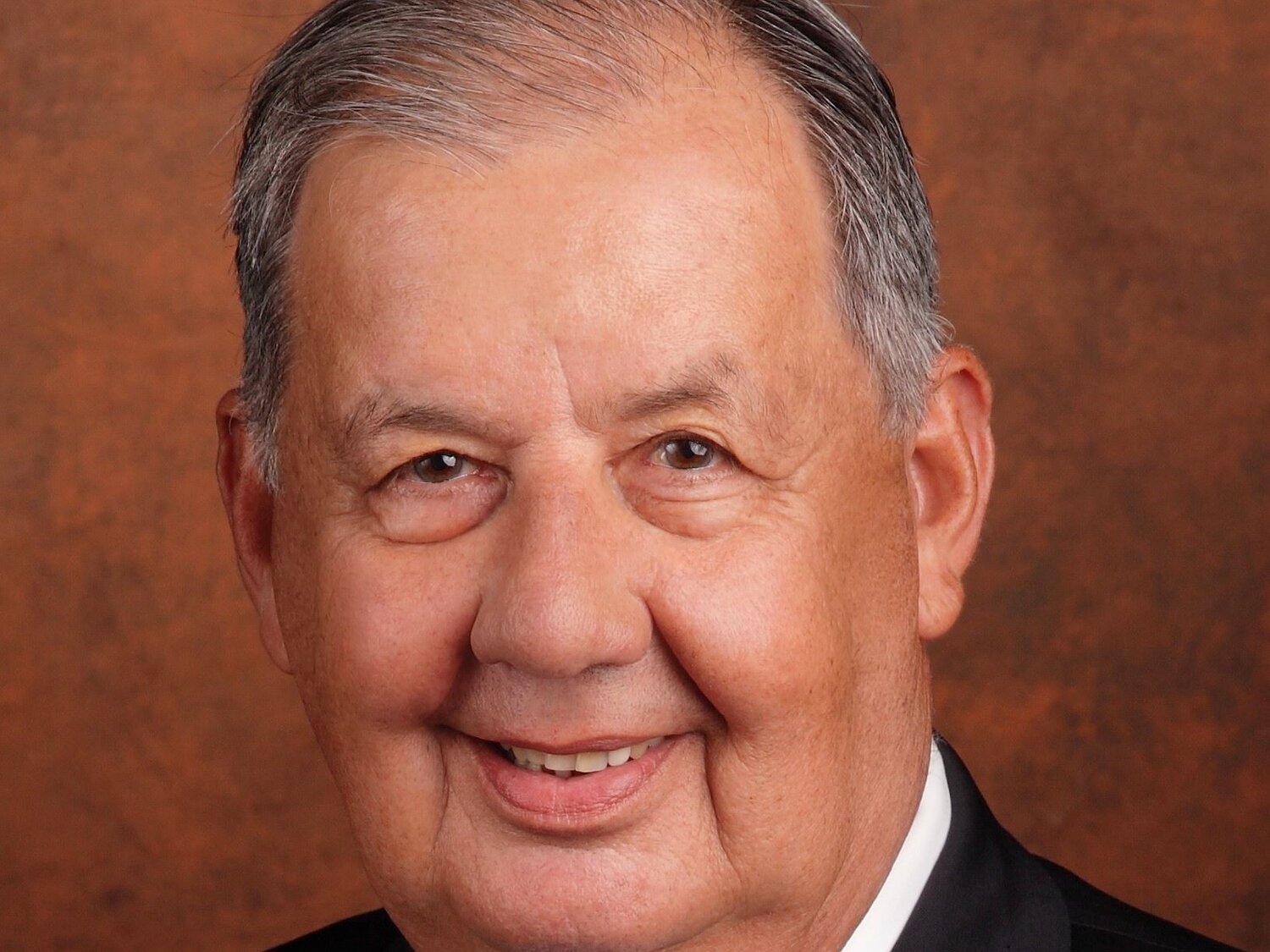
McALLEN, Rio Grande Valley — Looking ahead to the outcome of the Nov. 3 general election, Hidalgo County Judge Richard F. Cortez is calling on leaders from both major political parties to put partisan divisions aside and focus on working together for the betterment of the nation and the Rio Grande Valley.
Speaking on the Rio Grande Guardian’s podcast series Conversación alongside veteran broadcaster Ron Whitlock of Ron Whitlock Reports, Cortez stressed that national progress requires collaboration across party lines.
“We have to heal in the area of Democrats versus Republicans, Republican versus Democrats,” Cortez said towards the conclusion of the interview. “This country, I think, will always have a two-party system. So we might as well learn that we’re going to have a two-party system. We’re going to have to work together all the time.”
Cortez added that finger-pointing achieves little when addressing complex governance and economic challenges.“Defining the problem is only one part of the solution,” Cortez said. “The solution comes from the action that you take to solve the problem, and this is where both parties need to get together and say, ‘Okay, enough pointing fingers as to who’s to blame, how do we solve it.’ And I hope that comes right after November the third.”
The call for bipartisan cooperation served as the backdrop for a broader discussion on regional economic development and the critical role congressional seniority plays in securing federal investments for South Texas—specifically highlighting U.S. Rep. Henry Cuellar, D-Laredo.
Both Cortez and Whitlock have publicly endorsed Cuellar for re-election. The discussion follows a recent Rio Grande Valley Partnership Infrastructure Summit in Mission, where Cuellar noted that if Democrats regain control of the U.S.House of Representatives, his seniority positions him to become chairman of the House Appropriations Subcommittee on Homeland Security.
As subcommittee chairman, Cuellar would oversee a budget estimated between $309 billion and $311 billion, covering entities such as U.S. Customs and Border Protection (CBP), ICE, the Coast Guard, FEMA, and the Secret Service.
Cortez emphasized that having a border representative leading such a key spending panel would be a massive advantage for the Rio Grande Valley and the broader "Rioplex" region.
“The House of Representatives really controls the budget. They basically decide where monies are going to be used and utilized, and the controlling party decides who the chairman of all of those committees are,” Cortez said, comparing Cuellar’s potential leadership role to the historical impact of the late U.S. Rep. Kika de la Garza, who chaired the House Agriculture Committee for years.
“If Henry Cuellar should be the chairman of this... it’s huge,” Cortez added, noting that federal budget constraints make strong senior representation essential to secure needed capital.
During the podcast, Cortez outlined his long-term vision to build productive regional assets and attract private business investment to South Texas, reducing reliance solely on government funding.
“We want businesses to come here because they’re going to make more money here with us,” Cortez said. “And for that we need infrastructure. They’re looking for a reliable source of power, reliable source of water, reliable source of workforce... We locally cannot furnish all those on our own ticket, our own bank account. We’re going to need their help.So to have Henry Cuellar in that position is huge.”
Specific infrastructure priorities mentioned by Cortez include:
Whitlock cited analytical projections showing that replacing a 20-year congressional veteran with a freshman representative—regardless of political party—resets a region’s legislative seniority to zero, moving the area from having direct influence over federal purse strings to minimal bargaining power in major budget negotiations.
Cortez agreed with the assessment, pointing out that Cuellar ranks in the top 10 percent of House seniority among 435 members.
Throughout the broadcast, both Cortez and Whitlock highlighted Cuellar’s history of working across party lines and advocating for South Texas projects outside his immediate congressional district boundaries.
Whitlock pointed to past federal allocations for the dredging of Port Mansfield in Willacy County—a project where Cuellar collaborated with U.S. Sen. John Cornyn, R-Texas, to deliver tens of millions of dollars in federal infrastructure investment for one of the region's economically challenged areas.
Cortez noted that Cuellar’s willingness to challenge his own party on border security and trade issues demonstrates a pragmatic approach focused on local needs rather than party orthodoxy.
"A leader, by definition, has followers," Cortez concluded. "I want to be controlled by the leader."


