


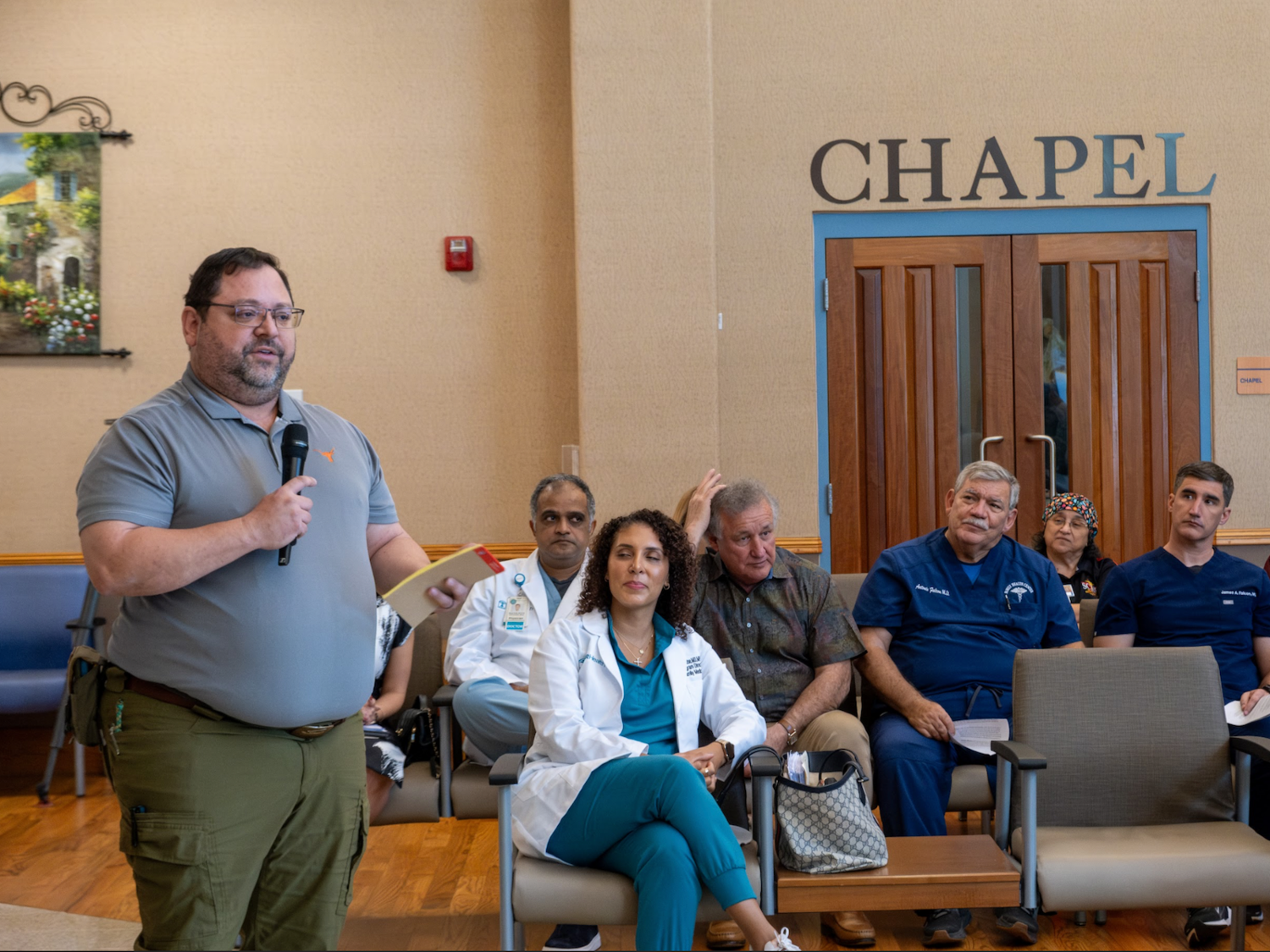
RIO GRANDE CITY, Texas - Starr County Memorial Hospital hosted the first regional stakeholder meeting with representatives from the Texas Health and Human Services Commission to seek public comment on how best to use a new batch of federal funds.
The funds have been set aside for rural hospitals in the One Big Beautiful Bill Act.
Trey Wood, chief financial officer for HHSC, was joined by John Henderson, president and CEO of the Texas Organization of Rural and Community Hospitals (TORCH), representing all 152 rural hospitals in the state.
Sitting alongside SCMH board members, the two gave a presentation broadly explaining the mechanics and stipulations of the Rural Health Transformation Program (RHTP) embedded within the OBBBA.
The program allots $50 billion over the next five years to the states for rural health initiatives. To receive any funding, states are required to submit a one-time application outlining their proposals. Half of the funds will be distributed evenly between the states (assuming all apply), with each receiving $100 million per year for five years. The other $25 billion will be awarded based on need.
Though the OBBBA was passed on July 4, the program was not officially launched until Sept. 15, with full details for the state application process. HHSC has sought public input since August, but, with the Nov. 5 deadline looming, it is now amping up its efforts to hear directly from rural communities to ensure that initiatives meet federal requirements and have lasting results.
 Roma Mayor Jaime Escobar, Jr. (Photo: Adrian Alfaro/RGG)
“That is certainly something that we are emphasizing – the sustainability piece,” said Wood. “This is not meant to just be a one-time infusion of money that’s going to occur for, you know, one year or the next five years. It’s what can we do with that money for the state that will make a lasting impact so that we’re not sitting here ten years from now – like that money is long-since gone – and we don’t really have something meaningful to replace it.”
The RHTP lists several categories under which funding can be sought, such as workforce development, telehealth and chronic disease management. Each state’s application must include initiatives for at least three of the categories, and funding cannot replace what has already been budgeted or covered by the state or other organizations.
HHSC identified four vulnerable demographics within rural areas that it will focus on: pregnant women, elders, uninsured individuals and youth under 20 years old. Woods said making sure that health care services continue for these groups, despite the $1 trillion in cuts to Medicare and other federal health care programs, is of the utmost priority.
 Rose Benavidez, president and CEO, Starr County Industrial Foundation. (Photo: Adrian Alfaro/RGG)
After their presentations, the oral comments were opened.
Elected officials and stakeholders from Starr and Hidalgo Counties spoke about the where the need lies in their communities. Four themes seemed to arise: transportation, emergency room overcrowding, training and retaining staff, and mental and behavioral health.
The first to speak was Maria Sanchez, executive director for Border Region Behavioral Health Center. She asked for money for a mobile unit to reach patients scattered across the county with no way to get to the clinic. Jesus “Jesse” Rios Jr., Roma I.S.D. board member and owner of Lino’s Pharmacy, agreed, saying that a mobile unit could help him and his staff ensure that patients fill and receive their prescriptions on time. Leticia Garza-Galvan, former Roma I.S.D. school board president and current candidate for Starr County Judge, pointed to the success of programs like Meals on Wheels that bridged the transportation gap during the pandemic. She says funding for similar ways to reach and treat patients remotely should be considered.

Dr. Javier “Jake” Margo Jr., a family physician in Rio Grande City, spoke of the overcrowding “epidemic” in SCMH’s emergency room. He estimates that between 20 to 30 patients are admitted to the ER every 12-hour shift, many of which are there for non-emergent conditions. Adding credence to the transportation issue, Margo explained that patients often use ambulance rides as a means to get the hospital because they do not have reliable transportation, and they do not have to pay for the service. For the uninsured, an ER visit is usually the first time a medical issue is addressed as they cannot afford to regularly see a primary care physician.
“Some of it, though, you’ll see is some of the patients don’t want to pay me – they really can’t pay anything,” said Margo. “And, if they’re asked to pay something upfront … you ask to pay $5, $10, sometimes they’re unwilling to do that, but if they go to the ER, they don’t have to pay anything.”
Margo says it is frustrating but futile to hound patients about medical bills or scold them about misusing the ER because their habits will not change until they have regular access to preventative care and treatment.
“That doesn’t help anything,” said Margo. “At the end of the day, they’re going to still be there, and we’ve got to take care of the patients. That’s what we’re here for.”

Cynthia Garcia Fuentes, wellness coordinator for Starr County, said the overcrowding has also spilled over to federally qualified health centers (FQHC) and urgent care clinics. She, like almost everyone who made a comment, said they are understaffed, and funding is desperately needed for training and recruitment.
Roma Mayor Jaime Escobar Jr. specifically highlighted the “heavy” demand for ambulance drivers and emergency medical technicians (EMTs). The grueling nature of the job, especially in a rural area, can deter people from the career. Other health care program options, like those offered by South Texas College that allow credits to be stacked towards a nursing degree, also siphon people away.
“A lot of our students are coming in, but they want to go into nursing and other things,” said Escobar. “We want to make it attractive for them to stay as an EMT or paramedic personnel.”
Escobar proposed incentives like loan forgiveness for those that remain as medical first responders in the area. Henderson liked the idea, saying infrastructure funding alone cannot fill personnel positions needed by rural communities.
“I love the way you framed it – and Trey mentioned this – one of the stipulations is this money can’t supplant existing funding,” said Henderson. “In the state legislative session there’s a bill – HB3000 – that through counties and county judges, it allows rural communities to get ambulances. What’s missing is the staff.”

Jayson Valerio, regional healthcare liaison for South Texas College, added that nursing students also need incentives to serve in their communities. He shared that students from Starr County would often choose to take classes at STC’s McAllen campus, instead of the Rio Grande City campus, to “be in the city” and visit nearby places like La Plaza Mall. After graduating, most go on to work in Hidalgo County as well.
Overall, though, Valerio says STC’s priority is addressing workforce shortages, and they need funding to hire more instructors to keep up with student demand. Despite innovative partnerships aimed to accelerate degree obtainment, like their DHR apprenticeship program, STC’s limited faculty cannot provide enough classes for the number of students wishing to enroll. Still, Valerio says the school is ready and willing to assist where they can with any proposal put forward by that state.
Dr. Naomi D’Acolatse, program director of the DHR Health Family Medicine Residency Program, agreed with everything brought up so far, but said the greatest disparity she sees is in mental and behavioral health services. Not only is there a major shortage of licensed professional counselors (LPCs) across the region, but treatment is just as inadequate.
D’Acolatse described seeing around 20 pediatric patients a day with suicidal ideation, who are then routinely discharged after a three-day hospital stay. Without trauma care counselors and behavioral specialists to follow up with them, young patients in the most precarious of situations are left on their own.

San Isidro Superintendent Elsa V. Morris spoke of her experience, such as needing to transport a student to San Antonio for the nearest open bed in a mental health facility. She also noted that many school counselors are not fully credentialed to properly treat students. While she is grateful for their work, Morris says the mental health crisis affecting today’s youth requires much more attention and resources.
“If there is anything that you take with you today it’s that behavioral health in our community is lacking,” said Morris. “Behavioral health is difficult to access … We just cannot meet the need and the demand of the need that is out there.”
She continued, to audience applause:
“Mental health doesn’t go away. It’s not a cough. It’s not a cold. It’s something that continues for the rest of that individual’s life.”
Wood and Henderson closed the comment session by thanking everyone on behalf of HHSC. Both praised the local leaders for already collaborating in so many ways to meet the needs of their communities. Henderson said that this will be to the region’s advantage once funds are released.
“When the money flows from the federal government, states are allowed to obtain up to 10 percent for administrative stuff, but I don’t think Texas wants to do that,” said Henderson. “That’s where planning activities at the state-level would occur, … but the way we view that is every dollar we keep in Austin, is a dollar that doesn’t get out here to you. So, the way I would think about your planning activities that are ongoing is, that’s your head start, right? You’re going to create local and regional solutions because we aren’t going to spend a lot of time in Austin planning for this. When the money flows, we want to get the money out.”
RHTP application approvals will be announced by Dec. 31.
Editor's Note: Reporter Adrian Alfaro contributed to this story from Rio Grande City.


