


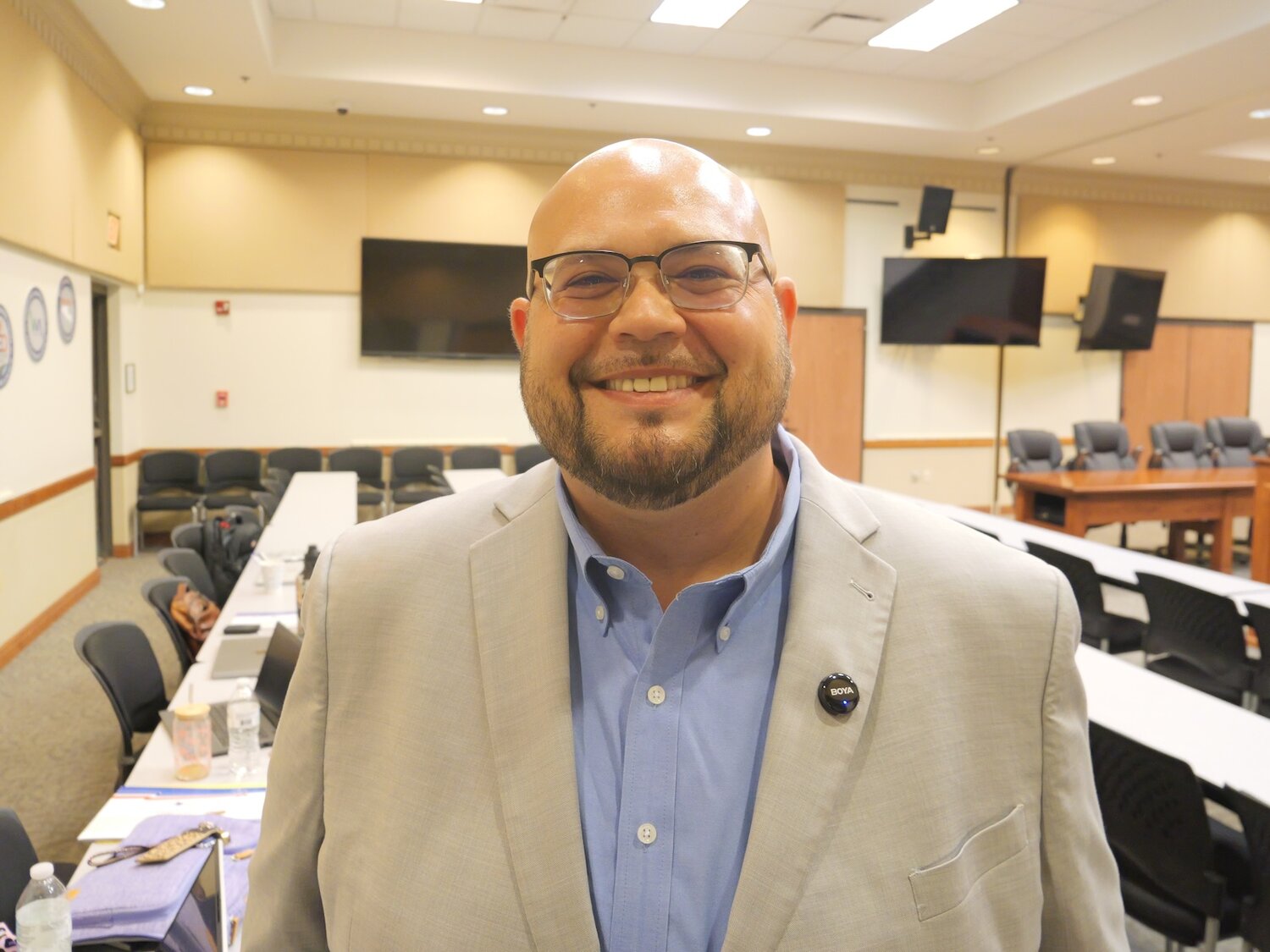
WESLACO, Texas - Fresh off leading the Rio Grande Valley Partnership's largest-ever delegation to the nation’s capital, President and CEO Paco Sanchez says the annual RGV-to-DC advocacy trip has set a new benchmark for regional collaboration.
The mid-June trip brought a record-breaking cohort of roughly 70 community leaders, city officials, chamber executives, and economic development professionals face-to-face with federal decision-makers to position the Valley for incoming federal resources.
"What we really wanted to do was bring in our communities, our cities, and our small businesses, and put them directly face-to-face with the federal decision-makers that authorize grants and distribute funds," Sanchez told the Rio Grande Guardian in an in-depth video interview.
"They can build that relationship and know exactly what they can be looking for to efficiently maximize their efforts and make the best use of taxpayer dollars."
The delegation included representation from Brownsville, Harlingen, Weslaco, Mission, and Edinburg, alongside institutional leaders from financial and healthcare pillars like Texas National Bank,, Texas Regional Bank, South Texas Health System, and DHR Health.
A core focus of the three-day trip was addressing the unique logistical challenges of the four-county region. Despite boasting land, air, and sea ports of entry, the Valley remains one of the largest metropolitan regions in the nation without a fully unified interstate network.
Sanchez said the delegation held crucial infrastructure briefings, meeting with William "Chuck" Garrison, director of the Federal Aviation Administration's Office of Airports Planning and Programming, to target planning grants for the Valley's five regional airports.
The group also met with Jennifer Shepard, executive director of the Alliance for I-69 Texas, to dissect the newly emerging America Build 250 Act—a major surface transportation bill expected to dictate freight movement. Sanchez noted that infrastructure advocacy is particularly critical for cargo-heavy hubs like Edinburg's airport.
"We are taking large trucks coming from our ports of entry that will unload and reload in our communities and then travel up our soon-to-be interstate system," Sanchez explained. "This kind of partnership increases our commerce and our economy. If you look at the industries in our area, all of them rely on the transportation and movement of goods."
He noted that Mid-Valley Airport in Weslaco is going to stress international opportunities in a new marketing initiative.
The delegation also held heavy-hitting talks regarding the Valley's labor landscape. The group huddled with Dr. Henry Mack, the Assistant Sectary of Labor Department to discuss regional workforce pipelines, drawing praise from federal officials for the proactive alignment between local Workforce Solutions boards and higher education institutions.
Sanchez revealed that federal agency staff were routinely surprised by data showing the Valley’s aggressive economic and workforce positioning, including the fact that state Rep. Oscar Longoria of La Joya chairs the important Permanent Standing Subcommittee on Workforce.
Sanchez said the region's unique leverage point as a global hub for aerospace technology took center stage during discussions with the Commercial Space Federation. Coming on the heels of SpaceX's historic market valuation heights, federal and non-governmental partners emphasized that the anchor industry significantly "de-risks" the region for secondary investors over the next five to ten years.
"If we can draw in our small businesses and get them into those supply chains—not just directly into SpaceX, but into pipe fitting, detailed data analysis, and collection—it will lift up everyone, not just in Cameron County, but in Hidalgo and Willacy as well," Sanchez said.
Sanchez said RGVP will likely hold a press conference soon to explain its success with the RGV-to-DC trip.
Looking beyond Washington, Sanchez addressed the long-standing regional effort to convince the federal Office of Management and Budget (OMB) to merge the Valley’s fragmented metropolitan designations into a single, unified Metropolitan Statistical Area (MSA).
Currently split primarily between the McAllen-Mission-Edinburg MSA and the Brownsville-Harlingen MSA, a unified designation would instantly elevate the region to the 42nd largest MSA in the nation, Sanchez pointed out.
"When you look at our GDP being at just under $41 billion if it was combined into one MSA, that speaks loudly for our region," Sanchez said, invoking the memory of his mentor and former RGVP champion Bill Summers, who spent years fighting for regional unification. "That will bring down large industry, raise our median incomes, and help our communities and our residents with their quality of life."
While OMB designations rely entirely on rigid data models—specifically a 25 percent county-to-county commuter threshold—recent data commissioned by the Council for South Texas Economic Progess placed the Valley's current cross-county labor migration interchange at 13.8 percent.
Sanchez expects booming industrial expansions at the Port of Brownsville, such as NextDecade LNG, and SpaceX to naturally bridge that remaining gap, forcing a data-driven merger.
"If the Port of Brownsville and Cameron County land those massive projects, bringing 10,000 workers, they are not all going to live in Cameron. A lot of them may live in Hidalgo," Sanchez noted. "That large-scale industry has permanent jobs paying over $70,000. That’s generational change from where I come from in Donna. It's a game-changer."
Sanchez said RGVP is currently building out its next phase of advocacy. He said this includes shifting its regional framework toward the state level.
The second half of the year will feature a series of legislative roundtables to iron out the Valley's unified priorities ahead of the next state legislative session, which starts in Austin next January.
Looking into the horizon, Sanchez confirmed dates have already been pinned down for the Regional Legislative Tour on January 21–24, 2027, followed immediately by RGV Days in Austin on February 2–3, 2027.
Here is a video recording of the interview:


