


Latin America and the Caribbean have long been considered the backyard of the United States. One may add to this backyard Canada and Greenland, due to recent developments. This is because the Western Hemisphere lacks a great power that may counterbalance the US preeminence, thus making it the dominant country in the region. Throughout history several countries have challenge the US dominance in the Western Hemisphere, including Spain, France, Britain, Netherlands, Russia, Japan and, most recently, the People’s Republic of China (PRC), so far, without succeeding.
The Latin American and Caribbean countries, compared to other developing nations in Africa, Asia and South Pacific, have economies with some infrastructure, important consumption capabilities, and the existence of a limited middle class, plus an important number of commodities and human capital resources. Some Latin American nations, however, are dependent mostly on commodities rather than manufactures for the improvement of income. But at least they have embraced democracy, so that power is contested in elections -with some exceptions, of course.
They face the challenges of organized crime, pandemics, natural disasters, geopolitical rivalries, but most of all, they are highly divided. They face wealth distribution imbalances and lack the required income to prosper since tax revenues are limited. This is why remittances are so relevant to many of them.
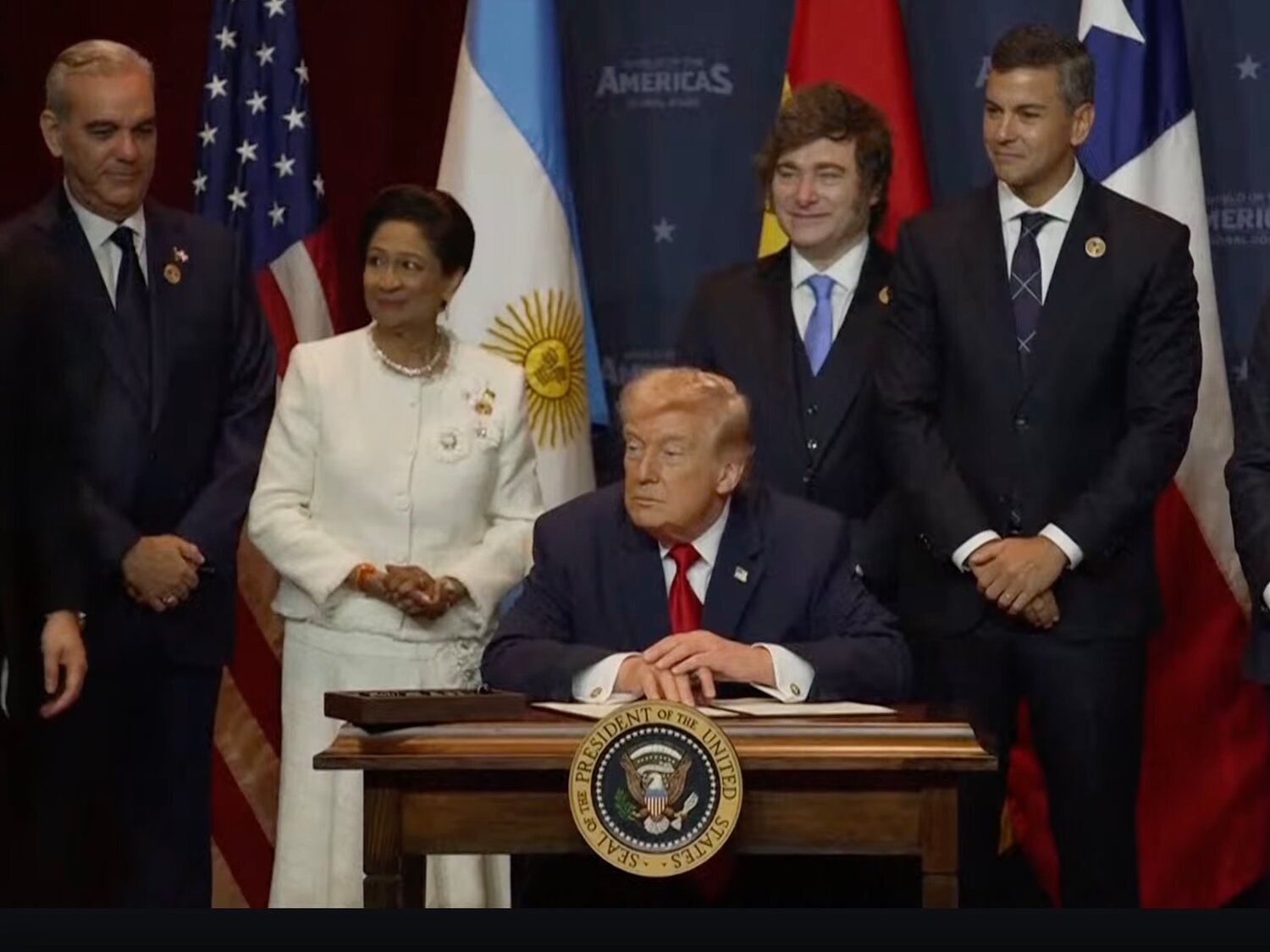
Last March 7, Donald Trump led a gathering in Miami, at his golf course, with 12 Latin American Presidents, plus representatives of another 5 countries to create the Shield of Americas, consisting on a consensus to face drug cartels and terrorists in the Western Hemisphere. The reunion took place after the region has been placed on top of the foreign policy of Donald Trump particularly during his second administration. This also puts an end to the Summit of the Americas, an initiative launched in December 1994 -in Miami too-, by President Bill Clinton to reinforce Inter-American relations and create a Free Trade Area of the Americas (FTAA).
The Summit of the Americas experienced some ups and downs. Nine gatherings took place every three years since 1994 and last year it was expected that the Dominican Republic would host the 10th, Summit. Yet it was cancelled because countries like Mexico and Colombia anticipated they would not attend, due to the exclusion of other Latin American nations that were not invited. It was said that the gathering in Punta Cana would take place in 2026. Not anymore. Instead, Donald Trump invited leaders that have a political and ideological empathy with him, like Argentina’s Javier Milei, El Salvador’s Nayib Bukele, Chile’s President-elect José Antonio Kast, Honduras Nasry Asfura, and others, to join him this past weekend in Florida.
Trump excluded from the meeting the biggest and most populated countries within the region, that is Mexico, Brazil and Colombia. The exclusion is ideologically motivated: progressives and leftists are not welcome. Yet Mexico was somehow present at the gathering when Trump said that its southern neighbor is the epicenter of criminal violence in Latin America. He also had some words of support for Mexico’s Claudia Sheinbaum, but the mood of the meeting was very much to agree on a militarization of the war on cartels with the participation of the invited countries.
Trump despises existing institutions and mechanisms in the Western Hemisphere to address the issues he cares most. There is the Organization of American States (OAS), an institution born in 1948 whose roots can be traced back to 1889-1890, when the First International Conference of American States took place. Then, there is the Rio Treaty that established in 1947 the first military alliance of the Cold War sponsored by the US within the region: the Inter American Reciprocal Assistance Treaty (TIAR). During WWII, the US promoted in 1942 the Inter-American Defense Board (JID) to face possible military threats coming from the Axis powers to the region. All these organizations still exist today but, apparently, Trump does not want to use them, despite the US being the dominant power in each of them.
Prior to the Summit of the Americas birth, the Cuban Revolution led US President John F. Kennedy to expand cooperation with Latin America and the Caribbean, fearing the spirit of the communists would influence other nations. The Alliance for Progress channeled resources to Latin American and Caribbean nations to diminish the risks of other revolutions/uprisings and to reduce the USSR influence in the area. The Inter-American Development Bank (IADB) was born in 1959 in that context to provide technical cooperation and more important, credits for different purposes, including infrastructure, health, education, trade, housing, small business and the growth of the private sector.
These institutions, except for the IADB, declined in relevance in the last decades of the Cold War. It was until Mexico signed with Canada and the US the North American Free Trade Agreement (NAFTA) that came into force on January 1, 1994, that the Clinton administration decided to revive the existing Inter-American institutions when it developed the Summit of the Americas initiative, whose administration would be in the hands of the OAS.
Compared to the Shield of Americas, the Summit of the Americas was more inclusive, to the point that the gathering that took place in Panama in 2015 made possible a historic reunion between then US President Barack Obama and the Cuban leader Raúl Castro on April 11. Diplomatic relations were officially restored on July 20, 2015, with both countries reopening embassies in their respective capitals.
Then came the first Donald Trump administration and the 8th Summit of the Americas held in Peru, where the US delegation was led by Vice-president Mike Pence. After that, under Biden, the US hosted the 9th Summit in Los Angeles -in the spirit of a “damage control” in Latin America after the Trump years-, skipped by the then President of Mexico Andrés Manuel López Obrador by arguing that the meeting excluded several countries like Cuba, Venezuela, Nicaragua, etcetera.
In a sense through its history the Summit of the Americas went from inclusion to exclusion and collapsed this year after Trump decided it is best to deal with leaders that agree with him. The Shield of Americas is also dividing an already highly polarized region, where leftist Governments collide with the libertarian Javier Milei, or the right-wing Javier Noboa to mention a few. Polarization has reached a worrisome point: a few days ago: the President-elect of Costa Rica, Laura Fernández, during an interview said that Mexico is the example of what the Central American country should not be, referring to the muscle organized crime has in the Mexican territory.
Instead of joining forces to address a common threat like organized crime, Latin American and Caribbean countries are divided on ideological and political grounds, plus the desire of the Trump administration to prevail over most of them taking advantage of the strengthening of right and ultraconservative Governments ruling the region. Not long ago, leftist Governments led most of the countries in Latin America and the Caribbean. Today there are only a few of them left.
At the same time, the Trump administration blames on Latin America and the Caribbean the flows of drugs into the American territory. Yet he does not mention that the major market for drugs consumption is in the US. Neither he assumes responsibility for the illicit traffic of firearms into Mexico, which provides fire power to drug lords. For instance, studies by the Bureau of Alcohol, Tobacco, Firearms and Explosives (ATF) constantly reveal that cartels typically acquire weapons through a combination of straw purchasers, unlicensed resellers, theft and specialized brokers who source firearms and ammunition from US commercial markets. In fact, around 80 percent of weapons seized from Mexican criminals come from the US and the efforts from Mexican authorities to even sue American retailers and companies that produce/sell firearms have been systematically blocked by US judicial bodies.
Mexican cartels possess military-grade rifles, high-capacity weapons and in some cases explosives, and have shot down Mexican military helicopters in 2015 by even using MANPADS, (Man-Portable Air-Defense Systems). So, the growth of the fire power of cartels is not only the responsibility of Mexico, that is paying a heavy price for fighting organized crime both in terms of human and material resources.
Donald Trump did not address these issues during the Shield of Americas meeting, but unless co-responsibility is recognized on the American side about the market for drugs inside the US and the illegal trafficking of firearms and military-sophisticated weapons, there is no way the war on drugs succeeds.
At his State of the Union address last February 24th, Donald Trump credited himself for hunting down the leader of the Jalisco New Generation Cartel, Nemesio Oseguera Cervantes, “El Mencho” two days before - February 22- in Jalisco, Mexico No credit for Mexico, despite the operation was led by Mexican security bodies -the US provided intelligence identifying the place where “El Mencho” stayed- and 25 Mexican military died during the confrontation to arrest the prominent criminal. Many Mexican cities and regions experienced the retaliation of the cartel once the dead of its leader was confirmed. There were many human casualties and businesses were destroyed plus institutions - like the Bienestar Bank branches, in charge of providing pensions and welfare programs to the population- were set in fire. But this was not considered by Trump. It is disappointing that his government does not recognize the price Mexico is paying for these operations. With the Shield of Americas in place the Western Hemisphere most probably will see more operations like these, serving Trump’s desire to show voters that he is doing a great job in hunting down criminals making America safer from violence, fentanyl and other drugs. But making America safer is not connected with making Mexico and/or other Latina American and Caribbean countries safer as well.
How about the rest of the agenda the Summit of the Americas used to endorse? As for the FTAA is concerned, this is clearly dead. The FTAA was modeled on NAFTA and this trade agreement was terminated by Trump on its first administration by arguing it was the worst trade deal ever. Not only that. The successor of NAFTA, the USMCA is about to die, since Canada-US Relations are at its lowest point these days, whereas last week Mexico and the US announced the beginning, ahead of schedule, of the review process of the trade deal without Canada.
Editor’s Note: The above guest column was penned by María Cristina Rosas, a professor and researcher in the faculty of political and social sciences at the National Autonomous University of Mexico in Mexico City. The column appears in The Rio Grande Guardian International News Service with the permission of the author. Rosas can be reached via email at: mcrosas@prodigy.net.mx


