


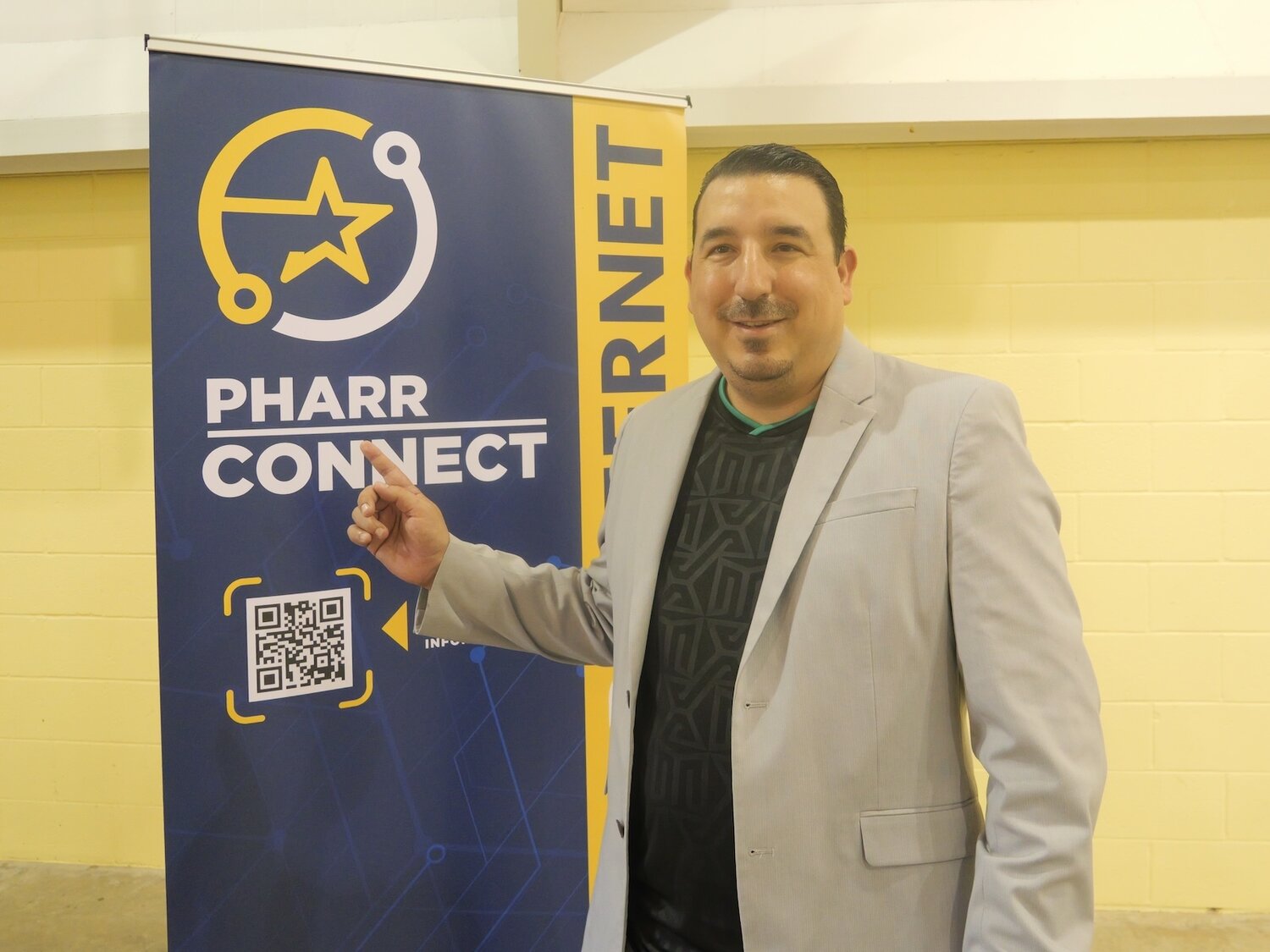
PHARR, Texas — In a major push to close the digital divide, the City of Pharr has expanded its municipal fiber-optic network, Pharr Connect, into local public housing complexes, providing ultra-high-speed internet to families previously left behind by private providers.
The city recently held ribbon-cutting ceremonies at three individual Pharr Housing Authority properties, bringing fiber-to-the-home connectivity to 300 apartments. The infrastructure expansion was funded through a strategic partnership utilizing federal Community Development Block Grant (CDBG) funds.
The three locations are Sunset Terrace on W. Egly Avenue, Parkview Terrace on W. Audrey Street, and Las Canteras on E. Thomas Road.
Jose Peña, who leads the Pharr Connect initiative, explained that the housing complexes—each containing 100 units—had long been identified by city staff and customer service teams as being severely underserved.
“We knew that these properties had been underserved when it comes to Pharr Connect, and they’re wanting the services, right, just like everybody else that lives in the rest of the City of Pharr,” Peña said. “They now can connect to Pharr Connect and have the same experience with fiber inside their home.”
Prior to the municipal expansion, residents in these aging complexes relied on legacy private-sector infrastructure, which often suffered from poor reliability and prohibitive pricing.
To address the economic barriers to technology, Pharr Connect introduced an aggressive pricing structure aimed squarely at low-to-moderate-income families. Residents can opt into an introductory symmetrical 500 Mbps package for $25 per month.
“That is unheard of in the industry,” Peña noted, adding that no other provider in the Rio Grande Valley can match the price. “This is a service that our Pharr City Commission and our Pharr Economic Development Corporation wanted—to make sure it was a reality for the community.”
Higher tier packages scaling up to one and two gigabits are also available, alongside outdoor Wi-Fi capabilities for backyards and common areas.
The expansion goes beyond basic hardware installation. Pharr has backed its infrastructure with a nationally recognized digital literacy program funded through Methodist Healthcare Ministries. Residents who complete the city's computer training classes receive a brand-new laptop at no cost. The city is also preparing to launch a workforce program designed to certify local individuals for jobs within the growing broadband industry.
Pharr Connect’s footprint continues to scale rapidly across the municipality. The network has surpassed 13,000 subscribers, representing a take rate of over 55 percent within the city limits.
The infrastructure has also transformed into a powerful corporate recruitment tool for the Pharr Economic Development Corporation (EDC) and the local Chamber of Commerce. The network currently services over 100 commercial clients, offering small business plans ranging from $70 to $200, alongside custom-tailored dedicated internet service lines for large-scale industrial operations.
Unlike cities that contract out their network development, Pharr manages its entire utility ecosystem internally.
“We do everything in-house,” Peña said. “We do engineering, we do construction, and we do the fiber connections all in-house for all commercial work. We've been very fortunate that we've been successful and have continued to reinvest in this network, reinvest in staff, having more broadband jobs here at the City of Pharr.”
The success of the network has caught the attention of neighboring Hidalgo County municipalities. Residents and businesses just outside Pharr city limits—in McAllen, San Juan, Edinburg, and Hidalgo—have increasingly inundated Pharr’s customer service lines requesting service.
While regional expansion remains a long-term aspiration, Peña emphasized that cross-border deployment ultimately relies on political consensus and aggressive grant writing, pointing to the city's track record with the Pharr International Bridge as a blueprint for funding major infrastructure.
“Regarding our neighboring communities, we’d love to have those conversations,” Peña stated. “It’s outside of my wheelhouse, and that’s where elected officials come on board, and then that’s where the funding is really key... Hopefully someday we can be in our neighboring cities.”
For now, the network remains hyper-focused on completing its internal footprint. Work is already underway on a fourth Pharr Housing Authority development, with two remaining complexes slated for fiber deployment shortly thereafter before the city shifts focus to private mixed-use developments.
Editor's Note: Here is a video recording of the RGG Business Journal's interview with Jose Peña:


