


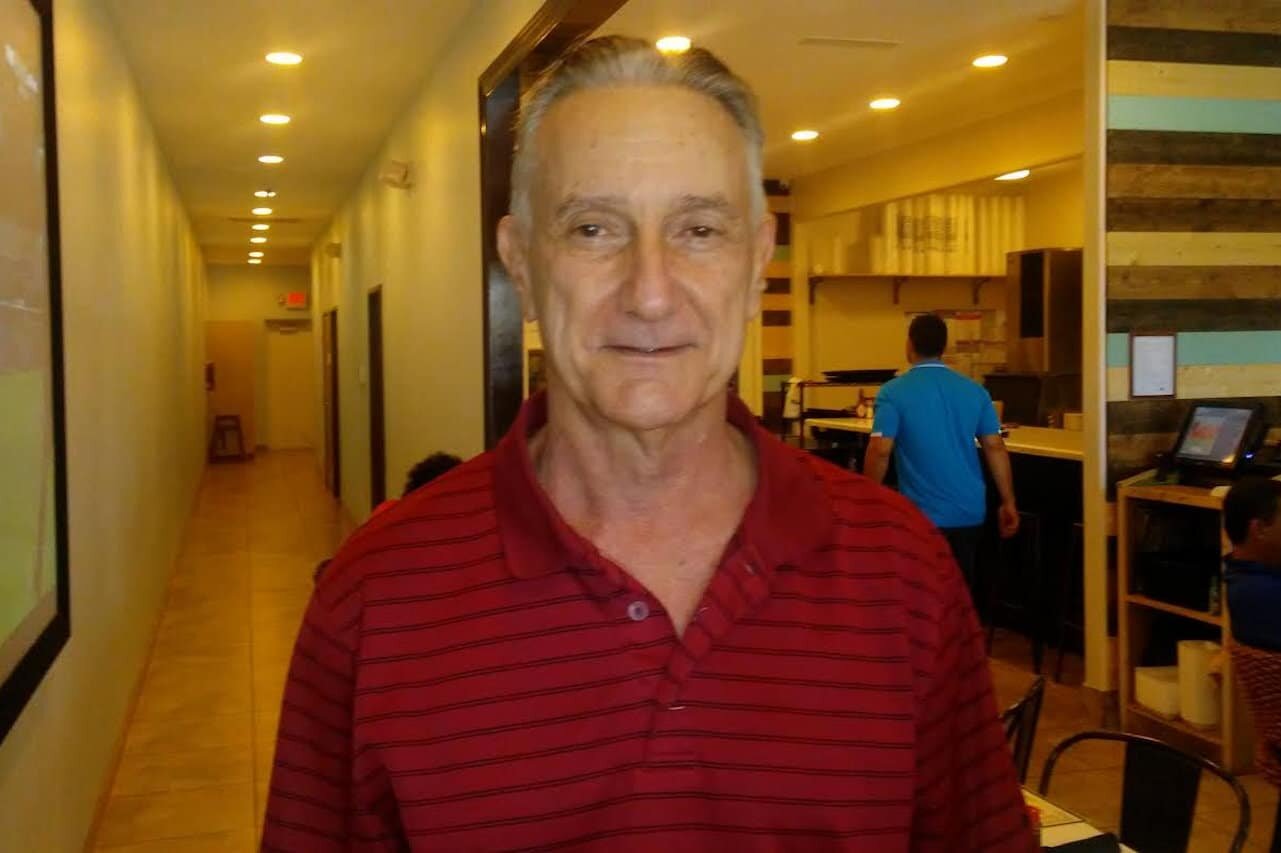
Dr. Samuel Freeman, Veteran of the Vietnam War (Captain, U.S. Army) and well-known professor at the University of Texas-Pan American (UTPA) and University of Texas-Rio Grande Valley (UTRGV), is leaving the Valley.
He will be missed. His students (of U.S. Government, Southeast Asian Politics, U.S. Foreign Policy) will miss him, of course. As a former colleague and fellow columnist for the Rio Grande Guardian, I shall also miss him.
Dr. Freeman arrived in the Valley thirty-seven years ago. He was an extremely well-prepared professor in the classroom and a popular lecturer. Campus auditoriums always filled for his debates on the 1st and 2nd Amendments of the Constitution or on Israeli-Palestine issues. He became a frequent guest for interviews in the media and a spokesperson in great demand on important, topical issues.
 Samuel Freeman during his U.S. Army days.
I remember clearly his leadership at key moments of confrontation: marching and flying what he called the “Big Dawg,” his huge U.S. flag, at a protest against President Bush’s invasion of Iraq. He endured the inevitable middle finger salutes and shouts of “Bomb Baghdad into a Parking Lot!” Later, at the “Black Lives Matter march in McAllen, he protected female students who were bullied by motorcyclist counter-protesters.
He helped the Environmental Club at UTPA and others save the Botanical Gardens of McAllen from designs to strip that historical gem to build tennis courts and apartments for private gain.
Indeed, the public interest has always been his focus. That focus inspired his columns in this newspaper about health care and, earlier, exposing those who called for invasion of Nicaragua.
In our several joint research trips to that country, Dr. Freeman—true to form—left the group. We had been relatively safe in Managua. But, no, this macho Vet had to go to the front lines, near the Honduran border, in order to “see for himself” the damage. Civilians—women and children—of Nicaragua had lost their lives. Important infrastructure and agriculture had been sabotaged by the U.S. funded “Contras,” former death squads of the dictator, Somoza.
Upon his return, to his classes and in public presentations, Dr. Freeman would report the facts and analysis of that sad period of history. It was hard. Even colleagues, supposedly liberal, refused to listen. The media generally bought into the administration’s “spin.” It took the “Iran-Contra” scandal to expose Reagan’s and Dick Cheney’s wrong-doings and to bring an end to that neo-colonial policy. Or do bad things never end? Eliot Abrams, of the same group of “invade Nicaragua” advisers, has recently been considered for the Trump White House.
Often controversial, Samuel was always at the leading point of discussions over major foreign and domestic issues. He and I often disagreed. Some of those arguments can be seen in past “Guardian” columns; e.g., on different sides of the Egyptian military coup; severe disagreements over the best Democratic candidates during the primaries. (Guess who he preferred)? But we managed to “disagree without being disagreeable.” Similarly, in classroom situations, Dr. Freeman—despite frequent internal and external political pressure—remained a demanding professor of integrity.
Some students, however, could not deal with the intensity—he gave no quarter if the student was not prepared with facts. Others thrived on the Socratic method and often heated classroom debates. Students were encouraged to respond, with their own points of views. He became our department’s official adviser, guiding students through the maze of hurdles leading to graduation. He helped aspiring students enter major Law Schools and graduate programs for their own Masters’ Degree or Ph.D. Then as now, Samuel was of special help to Veterans, some with PTSD. He helped them deal with medical problems and bureaucratic obstacles.
There is no greater legacy of Dr. Freeman’s tenure with the university and with the Valley than his firm, positive, consistent touch with individual students, placing them first in his priorities. He leaves now, but will continue to learn and to teach. He plans to travel, to Latin America and elsewhere. Perhaps, it will be an “I Shall Return” moment, a la General MacArthur, back to Vietnam for a closing, poignant visit. I wish him God Speed.


