


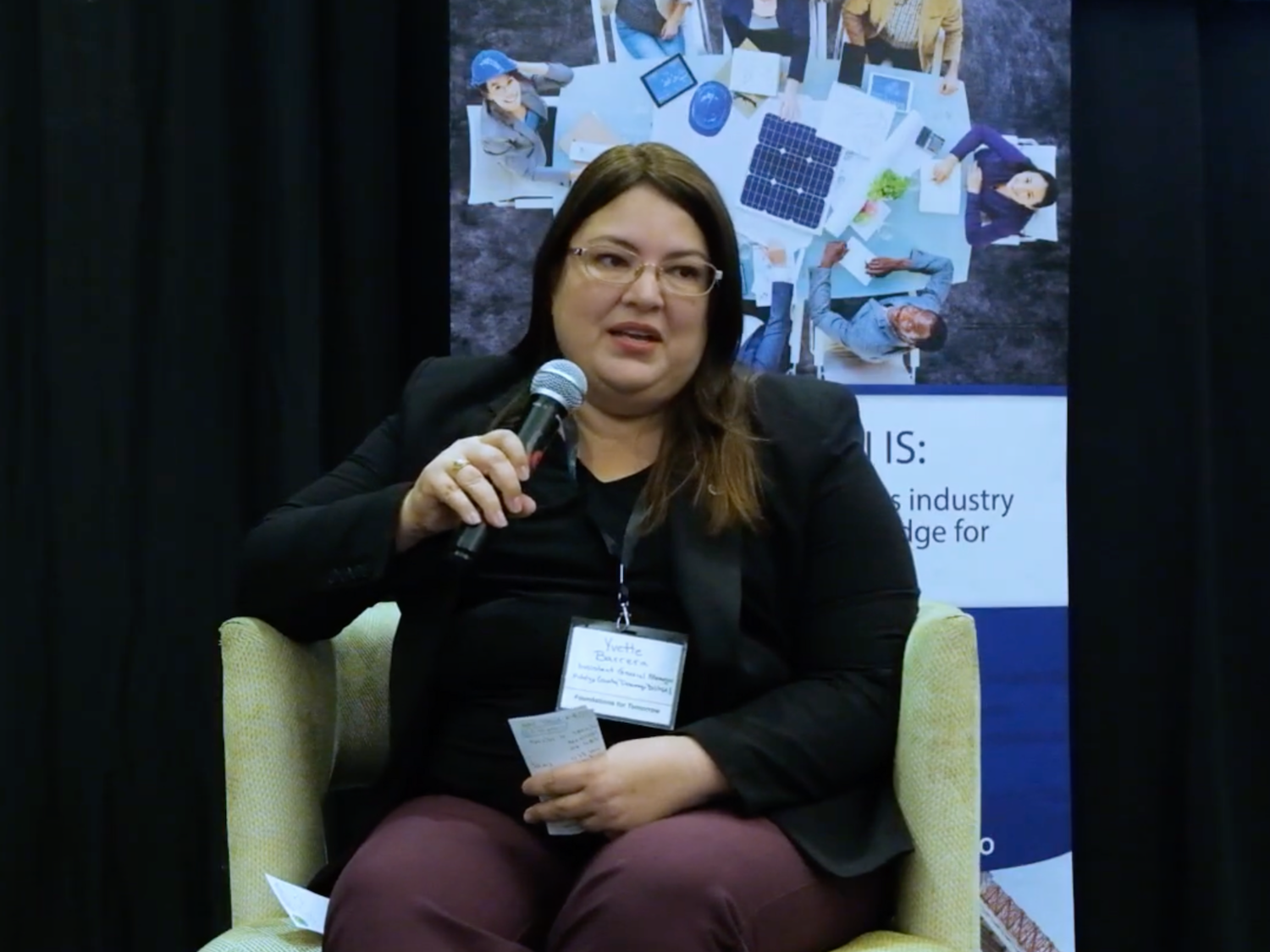
As development continues to accelerate across Hidalgo County, drainage systems originally designed for agricultural fields are now strained by rapidly expanding urban neighborhoods — increasing flood risk and requiring major infrastructure upgrades, said Yvette Barrera, assistant general manager of Hidalgo County Drainage District No. 1.
Barrera spoke during the “Foundations for Tomorrow: Infrastructure Demand for the Rio Grande Valley” luncheon hosted Nov. 19, 2025, by the Institute for Leadership in Capital Projects (I-LinCP) Rio Grande Valley chapter at Embassy Suites in McAllen.
The drainage district serves only 40% of the county’s land area, yet 90% of its population, putting intense pressure on a system never intended to support such density.
“Our drainage system was developed to serve agriculture,” Barrera said. “As land develops, the impervious area increases, and the system very quickly becomes overwhelmed.”
Older drainage infrastructure was built for 10-year storm events, based on rural runoff patterns. Now, concrete and paved surfaces move stormwater faster and in higher quantities — overwhelming ditches before water can naturally absorb into soil.
Municipal drainage networks outfall into the district’s man-made channels — ultimately tying into:
* The IBWC Main Floodway
* The Main Floodwater Channel
* The Raymondville Drain
* A more limited outfall at Arroyo Colorado
“We don’t have a natural river running through the region,” she said. “We have lots of small areas that essentially are bowls, and we must connect those bowls.”
After severe flooding in both 2018 and 2023, voters supported two bond programs totaling approximately $385 million for drainage upgrades across the district.
Key actions include:
* Widening and restoring 430 miles of drainage channels
* Adding hundreds of acres of detention ponds
* Acquiring additional right-of-way for future expansions
Most of the heavy excavation work is completed by contractors, but in some cases, in-house teams have doubled value for taxpayers.
Barrera highlighted several projects that have already shown significant performance improvements during the March 2025 storm event:
Mission Lateral (7 miles)
Prevented repeat flooding along the stretch north of 495 from Benson Palm Drive through McAllen — a corridor that overtopped during the 2018 flood.
Las Brisas & Chapa subdivisions (Weslaco)
39 acres of new detention, upgraded drainage, and an IBWC floodway outfall with a gate and pump — neighborhoods stayed dry in the latest heavy rains.
Raymondville Drain restoration
Using a $7 million RESTORE Act grant, in-house crews saved millions by removing sediment and restoring flow along a major regional outfall.
“These types of large-scale improvements are what is needed to make the system work,” Barrera said.
Barrera said drainage success depends on a twofold strategy: conveyance and storage.
Conveyance is the moving water efficiently out of neighborhoods and toward the Gulf, and storage, the holding of water temporarily in detention to control release rates.
She echoed TxDOT’s “spokes in a wheel” approach, multiple connected routes ensure the system does not bottleneck.
That also requires municipal policy support, urging cities to adopt ordinances requiring developers to retain stormwater on-site before releasing it into district channels.
When asked whether the Valley could store water that moves through the floodway during high-flow events, Barrera said the concept is not impossible but challenging.
It would require large land acquisitions at the right elevations, long-range design work and major excavation.
“It is a very long-term solution and requires quite a bit of planning to accomplish,” she said.
Barrera noted that climate variability, urbanization and rapid industrial growth will continue to stress drainage systems unless investments stay ahead of development.
“We see the impact these improvements make,” she said. “Our responsibility is to continue increasing capacity and working with our partners to protect our communities.”


