


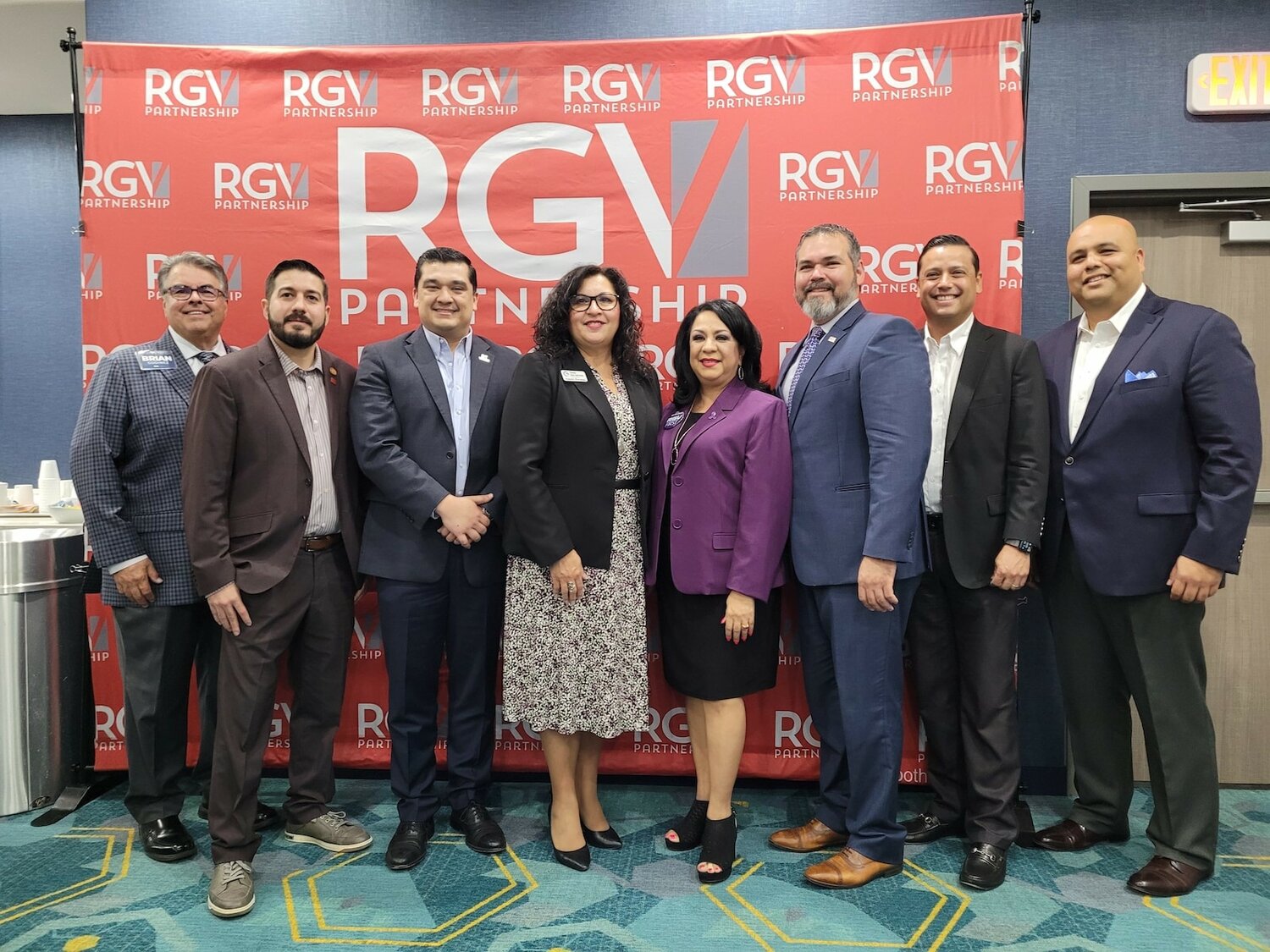
WESLACO, Texas - RGV First, a committee of the RGV Partnership, held its inaugural “State of the RGV Real Estate” forum in Weslaco with sponsors ERO Architects and Alamo Systems Industries.
The forum featured four panelists speaking about the latest construction and real estate development trends in the region within their scope of expertise. Brian Godinez, principal and chief marketing officer at ERO, was the master of ceremonies, introducing and transitioning between each speaker as well as moderating a Q&A session afterward.
Vanessa Hernandez, RGV Partnership’s director of membership and funding, wrote in a social media post that “the purpose of this initiative is for public and private entities to hire regional architects, engineers and contractors to ensure that our construction dollars remain in our region’s economy.”
Carlos Marquez, a member of the Society of Industrial and Office Realtors and principal at Partners Real Estate in San Antonio, represented the manufacturing sector. Carlos Telles, first vice president of commercial real estate brokerage CBRE’s McAllen office, focused on industrial warehouse development. René Alcalá, director of business development and Rio Grande Valley leasing and sales for Killam Development, discussed the current international landscape. And, Esteban Flores, committee chair for the Greater McAllen Association of Realtors and broker at Effective Real Estate, concentrated on the Valley’s commercial real estate development potential.
In his presentation, Marquez explained that the Valley will see more advanced manufacturing as businesses continue to grow their operations from just warehouse storage to some kind of assembly or distribution enterprise in the region.
“The RGV continues to be a great place for manufacturing,” said Marquez. “That's not EDCs saying that; that’s not brokers and developers; that is coming from the companies that are operating in this community. They are the ones that are giving positive references. They are encouraging other companies to come to the Valley and to consider locating down here.”
Marquez said areas of opportunity include businesses and suppliers involved in the production of electric vehicles, semiconductors and solar panels as new environmental regulations domestically and internationally go into effect. He used the example of Samsung moving suppliers to the U.S. and said that, unlike Austin, the Valley has the labor force to handle their demand.
Produce companies were also mentioned, as many are researching new food preservation technologies and want to expand their businesses for distribution to local restaurants and stores. Marquez said that this is a huge opportunity for developers that can provide a climate-controlled facility for these companies to cut and process their produce.
But, with any venture, there needs to be investment. While he acknowledged that these manufacturing projects require a much larger footprint and more complex planning and construction, Marquez says the undertaking must be done to secure these companies and the higher wages that come with them.
“Developers need to see buildings,” said Marquez. “I know it sounds easier than it really is, especially in today’s interest-rate environment, but if we want to land these deals, we do need valid plots … We don’t need to go over the top with all the bells and whistles, but we do need to build a higher-quality product if we want to win some of these advance manufacturing projects.”
He added, “We’re finally in the middle of all this growth in Mexico and Texas, and we just need to pull the trigger.”
Telles agreed with Marquez, highlighting the near-full occupancy they are seeing across the region’s industrial parks. He said that vacancies in these parks is so limited that some companies are contracting out their spaces to third parties. With such high demand seen across all industries, Telles urged developers to build on spec with these more advanced services and amenities in mind, saying that tenants will not be hard to find.
“This market distinguishes itself in that we are very diversified in the type of companies that we have down here,” said Telles. “It could be medical devices; it could be food processing centers; manufacturing, automotive – you name it, we have it.”
Telles presented average leasing figures by square foot to give the audience an idea of their possible return on investment. To further drive his point home, Telles spoke of an upcoming development project in Pharr with Majestic Realty, the largest privately-held developer in the U.S. Their project, dubbed the Majestic International Trade Port, will involve the construction of two top-of-the-line buildings on 600 acres of land near the Pharr-Reynosa International Bridge.
“The message there to the community is if those guys saw the potential in this market, that should tell you how well-positioned we are,” said Telles.
Alcalá explored some of the factors driving this boom in our region in his presentation. Near-shoring, by far, is having the biggest impact, with Mexico coming out a huge winner.
As a result of the USMCA, supply chain issues experienced during the COVID-19 pandemic, and war tensions in Russia and elsewhere, companies are now moving their operations closer to their end-user. Even Chinese companies are expanding or relocating, making up about 50 percent of the near-shoring happening in Mexico today.
However, the prosperity is not being seen equally across the country. Alcalá presented the first quarter growth figures for the Mexican states bordering Texas. Chihuahua, Coahuila, Nuevo León and Tamaulipas grew by 3.3%, 2.7%, 3.4%, and -0.1% respectively. While this may be good for Laredo, it does not bode well for the Valley.
“We see Nuevo Leon, we see Coahuila, we see Chihuahua … are focusing a lot on near-shoring,” said Alcalá. “Then we see our neighbor, Tamaulipas, is really kind of asleep at the wheel right now. We don’t see a lot of push to try and get these companies to Tamaulipas. … That is pretty much an issue for us. … We want to see some of that activity over here as well.”
For perspective, Telles said the growth Nuevo León reported is about half the size of the entire RGV market. Because of this, Alcalá says stakeholders from across the region need to come together and address the possible reasons for why Tamaulipas is being overlooked.
“I think the RGV Partnership is a great conduit to do this,” said Alcalá. “Get the cities together; get the economic development corporations together. Let’s go visit Tamaulipas. Let’s go see what they have going on. Let’s go see what their plans are. Let’s go see how their vision fits our vision because this is not going to work if we don’t have the same vision that they do.”
Despite these issues, Flores says the region is still positioned to absorb much more business. Geographically, the Valley is approximately 350 miles from Houston, 145 miles from Monterrey and next door to Reynosa and Matamoros – all major hubs of trade and commerce. The RGV is the fifth largest metropolitan statistical area in Texas with infrastructure that includes airports, railroads, bridges and a sea port.
“The RGV is strategically located,” said Flores. “And, in real estate, there’s a turn of phrase: ‘location, location, location.’”
Flores also said the growing skilled workforce, low cost of living and quality of life are draws for businesses, evening pointing to McAllen being listed as the third safest city in the country by SmartAsset.com. He said the region owes a debt of gratitude to those leaders who came before and worked to build what we are all now benefiting from.
“Right now is a great time to be in the RGV,” said Flores. “I feel like we are in the right place at the right time.”
RGV Partnership President and CEO Daniel Silva said he was happy with the forum’s turnout and discussions. He said the coalition will be hosting more events through RGV First to promote more regional investment projects.
“We want to make the community aware of what developments we have going on in the region on all different industries – manufacturing, industrial warehouse and commercial development,” said Silva. “It’s important for us to know what’s going on in the Valley so that way we can continue to push efforts – you know, try to bring in our local builders, architects and engineers – and we’re going to continue to showcase everyone that we have here in the Valley.”


